
Balance Therapy in Glendale, AZ

How Balance Therapy Works
Balance involves your muscles, joints, inner ear, vision, and the way your brain and body communicate.
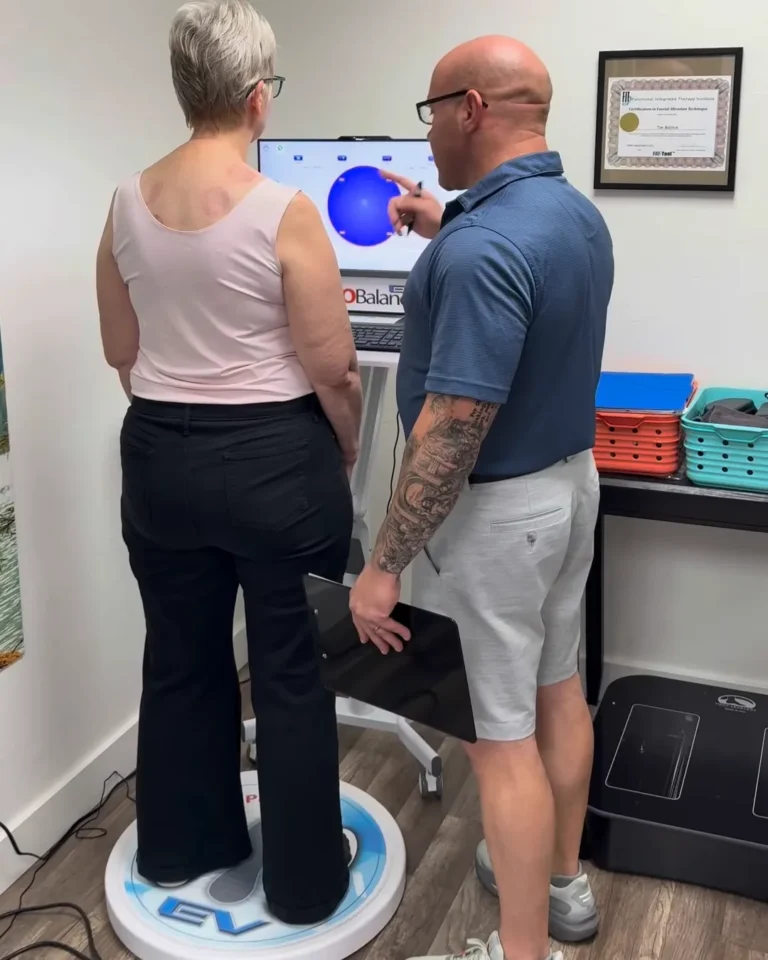
Dr. Tim uses ProBalance 360 and the Mechanical Motion suite from ProAdjuster for balance and motion services. In Balance Therapy, you stand on a balance plate and complete computer-guided tasks. Because the process is computerized, assessment and training follow a structured, consistent approach.
Your plan is built around your assessment results and what you want to be able to do, so the tasks used vary from patient to patient.
Who May Benefit?
Balance Therapy may help people who:
- Feel unsteady on their feet or worry about falling
- Are returning to activity after an ankle, knee, or hip injury
- Notice reduced coordination
- Want to stay active and independent
Sudden dizziness, new balance problems, or falls can have medical causes that need prompt evaluation. If your symptoms are new or getting worse, Dr. Tim may refer you to your primary care provider or another specialist.
What to Expect
Initial assessment. Your first visit includes a conversation about your health history and goals, followed by an initial examination. The initial assessment records six metrics, including static balance scores, dynamic balance scores, grip strength, and hip external rotation. Dr. Tim explains what he finds and recommends a plan.
Treatment sessions. Treatment sessions are where the training happens. You stand on a balance plate and work through computer-guided tasks chosen for your plan. Dr. Tim reviews your progress at follow-up visits and adjusts your plan as needed.
Frequently Asked Questions
Is Balance Therapy only for older adults?
No. It may help athletes, active adults, and anyone who wants to feel steadier and more confident on their feet.
What does a treatment session involve?
You stand on a balance plate and complete computer-guided tasks that are part of your plan. Dr. Tim oversees the session and adjusts your plan as you progress.
What should I wear?
Wear regular, comfortable clothes and bring or wear socks. Some patients prefer to do the activities barefoot.
Why use a computerized process?
The computerized process gives assessment and training a structured, consistent format from visit to visit.
What if I feel dizzy?
Tell Dr. Tim about any dizziness. New, sudden, or worsening dizziness should be evaluated by a medical provider.
How does Balance Therapy relate to Longevity Therapy?
Balance Therapy is one of the three components of Longevity Therapy at Muscle Chiropractic, along with Mechanical Motion Therapy and Cognitive Therapy.
What happens at the free assessment?
Dr. Tim starts with your health history and goals, then records six measures, including static and dynamic balance on the ProBalance plate, grip strength and hip external rotation. He explains what he finds and whether a program may help. It takes about 15–30 minutes. It is assessment only: no treatment is given, and no purchase is required. The assessment does not diagnose any medical or neurological condition; if Dr. Tim sees something that needs medical evaluation, he will tell you. It is also separate from a New Patient chiropractic visit, so if you want care for pain or an injury, book a New Patient Visit instead.
Who will I see?
Dr. Tim Ballitch, a chiropractor since 2017 who works with athletes and active adults. Learn more about Dr. Tim.
Do you bill insurance?
No. Muscle Chiropractic is a cash-based practice. HSA and FSA cards are accepted.
Related Services
Balance Therapy is one of the components of Longevity Therapy and may be combined with Mechanical Motion Therapy, ProAdjuster adjustments, or Chiropractic Care. It can also be part of recovery from Sports Injuries.
Balance, Cognitive and Motion Therapy (MMT): how they differ
- Balance Therapy trains steadiness: you stand on the ProBalance plate and complete computer-guided balance tasks.
- Cognitive Therapy uses the same plate but adds tasks that ask you to think and react while you move, so your attention and movement are trained together.
- Mechanical Motion Therapy looks at how specific movements perform (strength, control, stability, coordination and range of motion) and targets the patterns that need work.
Dr. Tim recommends one, two or all three depending on your assessment; together they make up Longevity Therapy. They aim to improve how you move and balance. They do not guarantee you will not fall, and they are not a treatment for memory loss or dementia.
Balance work is often part of recovery from knee pain, joint pain and stiffness and sports injuries such as ankle sprains.
Schedule With Dr. Tim in Glendale
Ready to check your balance? book your free assessment online or call/text 480-740-9619 to schedule it with Dr. Tim at Muscle Chiropractic, 7155 W. Campo Bello Dr., Building B, Suite B-115, Glendale, AZ 85308. This is our only office; patients visit from Peoria, Surprise, Sun City, Sun City West and North Phoenix. Want chiropractic care for pain as well? Book a New Patient visit online. Already a patient and want chiropractic care? Book an Existing Patient Visit, even for a new problem. To start balance therapy, existing patients book the free assessment, the same as new patients.