Tendonitis & Tendon Pain Treatment in Glendale, AZ
Tendonitis (also spelled tendinitis) is the everyday name for pain in a tendon, the tough cord that connects muscle to bone. Clinicians often call long-lasting tendon pain tendinopathy, because it usually isn’t mainly inflammation: the tendon has become painful and less able to handle load. At Muscle Chiropractic in Glendale, AZ, Dr. Tim Ballitch helps everyday patients and athletes with tendon pain in the elbow, shoulder, wrist, knee, hip, Achilles and more.
Your first visit starts with an exam. Dr. Tim works out which tendon is involved, tests how it handles load, checks nearby joints and muscles, and tells you when imaging or another provider is the better first step. Our only office is at 7155 W. Campo Bello Dr., Building B, Suite B-115, near Arrowhead Towne Center; many patients come from Peoria, Surprise, Sun City, Sun City West and North Phoenix.
Have tendon pain? Choose your visit:
- New patients who have never been seen at Muscle Chiropractic (ages 12+): Book a New Patient Visit — about 30 minutes, including your history, exam and an adjustment when appropriate. $154.13 (credit card price).
- Existing patients, including for a new problem: Book an Existing Patient Visit — $67 (about 15 minutes).
- Mainly interested in shockwave? If you want to know whether radial shockwave fits and need an exam first, book a $52.78 Shockwave Consultation (about 15 minutes) instead of a New Patient Visit. No adjustment or shockwave treatment is included.
- Questions first? Call or text 480-740-9619. More booking details.
Prices shown are credit card prices. A cash discount is available when paying at the time of service.
Where is your tendon pain? Find the right page
This page is an overview. Each area below has its own page with more detail.
- Shoulder: rotator cuff tendon pain, often when lifting, reaching overhead or lying on that side, including calcific tendinitis. See shoulder pain care.
- Elbow: tennis elbow on the outside and golfer’s elbow on the inside, usually from gripping, lifting or swinging. See elbow pain, tennis elbow and golfer’s elbow care; golfers can also see golf injuries.
- Wrist and hand: tendon pain along the forearm or on the thumb side of the wrist, often from gripping, typing, tools or lifting a child. See wrist and hand pain care.
- Achilles: pain and morning stiffness at the back of the ankle, often with running, walking or stairs. See Achilles tendon pain care.
- Heel: plantar fasciitis is not a tendon problem, but it is an overuse problem managed in a similar way: pain under the heel with the first steps of the day. See heel pain and plantar fasciitis care.
- Knee: patellar tendon pain just below the kneecap with jumping, squats or stairs. See knee pain care.
- Hip: pain on the side of the hip often involves the gluteal tendons and is commonly worse lying on that side or climbing stairs. See hip pain care.
- Other tendons: biceps, triceps, hamstring, quadriceps and other tendon pain is evaluated here too. Book a visit or call/text 480-740-9619.
Tendonitis, tendinitis or tendinopathy?
“Tendonitis” and “tendinitis” are two spellings of the same word. The “-itis” means inflammation, and a recent flare after a sudden jump in activity can involve some. But tendon pain that lasts for weeks or months usually isn’t mainly inflammatory, so tendon experts recommend the term tendinopathy for persistent tendon pain and loss of function related to load. That is why care focuses on helping the tendon handle load again, not only on calming it down.
What your assessment involves
Your first visit starts with your history: when the pain started, what aggravates it, your training or work load and any treatment you have already tried. Dr. Tim then examines how the area moves and tolerates load, checks strength and nearby joints and soft tissue, and looks at related areas, such as the neck and wrist for elbow pain or the ankle and calf for heel and Achilles pain. He will explain what he finds and whether care here makes sense, or whether imaging or another provider is a better first step.
How we treat tendon pain
Your plan is individualized from your exam and goals, and may combine:
- Corrective exercise and progressive loading: the core of tendon care. Dr. Tim picks strength exercises for the involved muscle and tendon and progresses them, for example from holds to slow strength work to faster, sport- or job-specific movements, while keeping pain at an acceptable level.
- Activity modification: complete rest is rarely needed. You get practical changes to training, running, lifting, grip or work tasks so the tendon can settle while you stay active.
- Soft tissue work: instrument-assisted soft tissue mobilization (IASTM, or scraping), cupping, manual release, or targeted pressure applied to selected muscle areas, used to ease tightness and help you move more comfortably. It supports exercise rather than replacing it.
- Chiropractic adjustments of related joints, by hand or with the ProAdjuster, when your exam supports it, and kinesiology taping when appropriate.
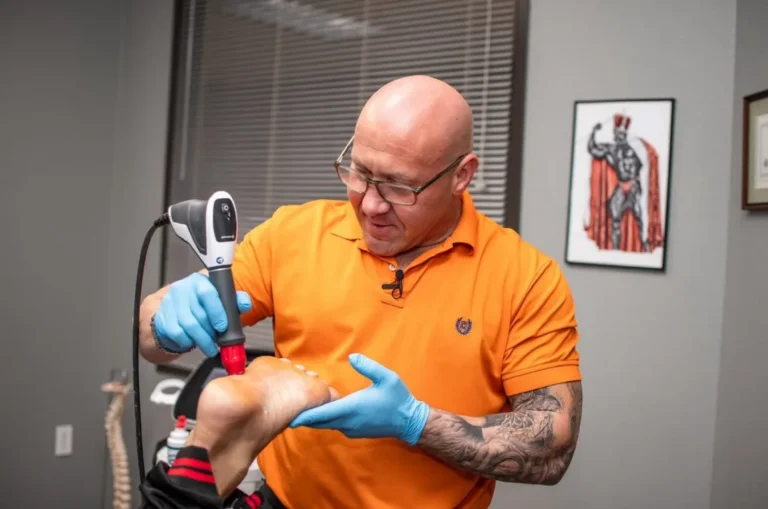
- Radial shockwave (radial pressure wave therapy) for some persistent cases after Dr. Tim decides whether you are a suitable candidate. The evidence differs from one tendon to another (see below), so it is not offered as a cure-all.
- Class IV laser, a separate service Dr. Tim may use for some tendon and soft tissue problems, mainly around the elbow, forearm and hand. Research on laser varies by condition and device and does not support it for every tendon.
Soft tissue work, corrective exercise and taping are included in New Patient and Existing Patient chiropractic visits when appropriate; there is no separate fee or booking. Shockwave is priced separately from the chiropractic visit ($103.50 for a single session, credit card price), and Class IV laser is also a separate service.
Limitations and when to get checked first
Tendon problems often take weeks to months to settle, even with good care, and no treatment works for everyone. Seek prompt medical care if you felt a sudden snap or pop (for example at the back of the ankle or the front of the elbow), cannot bear weight or use the arm, have significant swelling, redness or fever, have numbness or weakness, or your pain started after a fall or accident. Dr. Tim will refer you when another provider or imaging is the better route.
What the research shows
- Terminology: an international tendon research consensus recommends “tendinopathy” for persistent tendon pain and loss of function related to load, and notes imaging is not always needed to diagnose it (Scott et al., Br J Sports Med, 2020).
- Loading exercise: a 2024 clinical practice guideline recommends tendon-loading exercise as first-line care for midportion Achilles tendinopathy (Chimenti et al., JOSPT, 2024). In a randomized trial of patellar tendinopathy, a progressive tendon-loading program gave better results at 24 weeks than eccentric exercise alone (Breda et al., Br J Sports Med, 2021).
- Tennis elbow: in a randomized trial, elbow mobilization with exercise helped more than wait-and-see at six weeks; by one year most people improved, and corticosteroid injection had worse long-term results with more recurrences (Bisset et al., BMJ, 2006). A Cochrane review found little or no benefit from shockwave for tennis elbow (Buchbinder et al., Cochrane, 2005), so we do not present shockwave as a first choice for it. Golfer’s elbow has been studied much less, so care is guided by your exam and response.
- Plantar heel pain: adding high-load strength training to stretching improved function more than stretching alone at three months, with similar results by one year (Rathleff et al., Scand J Med Sci Sports, 2015). For chronic plantar fasciitis, radial shockwave improved pain and function more than sham in a placebo-controlled trial (Gerdesmeyer et al., Am J Sports Med, 2008).
- Shockwave differs by tendon: for long-standing midportion Achilles pain, low-energy radial shockwave and an exercise program gave similar results at 4 months (Rompe et al., Am J Sports Med, 2007). In jumping athletes still competing with patellar tendon pain, shockwave alone was no better than placebo (Zwerver et al., Am J Sports Med, 2011). For calcific shoulder tendinitis, the supporting trials mostly used focused shockwave, which is a different technology from the radial device we use (see our shockwave page). Results for one tendon or device don’t automatically apply to another.
Results vary, and no specific result is guaranteed.
Video: a tip for band and corrective exercises
In this 26-second video, Dr. Tim explains why the constant resistance of exercise bands can lead to overuse irritation, and suggests pausing at the bottom of each rep so the muscles can relax. If tendon pain keeps coming back, have it examined.
Common questions
Is tendonitis the same as tendinitis or tendinopathy?
Tendonitis and tendinitis are the same word spelled two ways. Tendinopathy is the term many clinicians now use for persistent tendon pain, because it usually isn’t mainly inflammation.
Do I need shockwave?
Not necessarily. Many tendon and heel problems are managed with exercise, load changes and soft tissue work. Shockwave is considered for some persistent cases after an assessment and is priced separately.
How many visits will I need?
That depends on your exam and how you respond. Your visit plan is not a preset package.
Can I keep training or working?
Often yes, with changes. Dr. Tim will suggest which activities to modify and how to build back up.
Do I need an X-ray, ultrasound or MRI first?
Not usually. Most tendon and heel problems are assessed from your history and exam. Dr. Tim will recommend imaging or a referral if something suggests a tear, fracture or another cause.
I’m already a patient and have new tendon pain. What should I book?
Book an Existing Patient Visit, even for a new problem.
Should I book a New Patient visit or the Shockwave Consultation?
If you want a full assessment and care that may include hands-on treatment and exercise, book the New Patient visit. If you only want to find out whether shockwave is appropriate for you, book the $52.78 Shockwave Consultation. Neither visit includes a shockwave treatment.
Do you take insurance?
Muscle Chiropractic is a cash-based practice and does not bill health insurance. HSA/FSA cards are accepted.
Related care
Shoulder pain · Elbow pain · Wrist & hand pain · Achilles tendon pain · Heel pain · Knee pain · Hip pain · Shockwave therapy · Soft tissue therapy · Sports chiropractic · Sports injuries · New patient center
How to book
Choose the visit that fits, and tell us which tendon area is bothering you.
- New to Muscle Chiropractic (ages 12+)? Book a New Patient Visit — about 30 minutes: history, exam, and an adjustment and corrective exercise when appropriate. $154.13 (credit card price). See what to expect and bring.
- Already a patient, including for a new problem? Book an Existing Patient Visit — $67 (credit card price).
- Only want to know whether shockwave suits your tendon or heel, and need an exam first? Book the $52.78 Shockwave Consultation — about 15 minutes: history, exam and candidacy check only; no adjustment or shockwave treatment.
- No online time that works? Call or text 480-740-9619.
Prices shown are credit card prices. A cash discount is available when paying at the time of service.