
Heel Pain & Plantar Fasciitis Treatment in Glendale, AZ
Does your heel hurt with your first steps out of bed, after sitting for a while, on longer walks or when you go back to running or training? At Muscle Chiropractic in Glendale, AZ, Dr. Tim Ballitch examines your foot and how you move before recommending care. Plantar fasciitis is a common cause of heel pain, but it is not the only one.
Choose the right visit
- Already a patient? Book an Existing Patient Visit — $67, even for a new heel problem.
- New to Muscle Chiropractic and want an evaluation and chiropractic care (ages 12+)? Book a New Patient Visit — $154.13: about 30 minutes, with your history, an exam and an adjustment when appropriate. See what to expect.
- Only want an opinion on shockwave? Book a $52 Shockwave Consultation: about 15 minutes of history and examination to decide whether shockwave fits. It is assessment only and does not include an adjustment or a shockwave treatment.
Prices shown are credit card prices. A cash discount is available when paying at the time of service.
Questions first? Call or text 480-740-9619.
What can cause heel pain?
Plantar fasciitis is irritation of the plantar fascia, the thick band of tissue along the bottom of your foot that attaches to the heel. It typically causes pain under the heel that is worst with the first steps in the morning or after sitting. Pain at the back of the heel is more often related to the Achilles tendon. A stress fracture, an irritated nerve, arthritis or a bruised heel pad can also cause heel pain, which is why Dr. Tim examines you first instead of assuming every sore heel is plantar fasciitis.
How Dr. Tim evaluates heel pain
Your visit starts with your history: when the pain started, what makes it worse, your work, footwear and activity, and anything you have already tried. Dr. Tim then examines your heel, foot and ankle, checks your calf, and looks at related movement such as how you walk, squat and balance on one leg. He explains what he finds and whether care here makes sense, or whether imaging or another provider is a better first step.
Care options Dr. Tim may recommend
Your plan depends on your exam and how you respond. It may include:
- Exercise and load changes: calf and foot strengthening, stretching where it helps, and practical changes to walking, standing, running or training while your heel settles.
- Soft tissue care: hands-on muscle release and IASTM (instrument-assisted soft tissue work, also called muscle scraping) for the calf and foot.
- Foot and ankle adjustments when your exam shows a joint that isn’t moving well.
- Class IV laser therapy when Dr. Tim thinks it fits your plan.
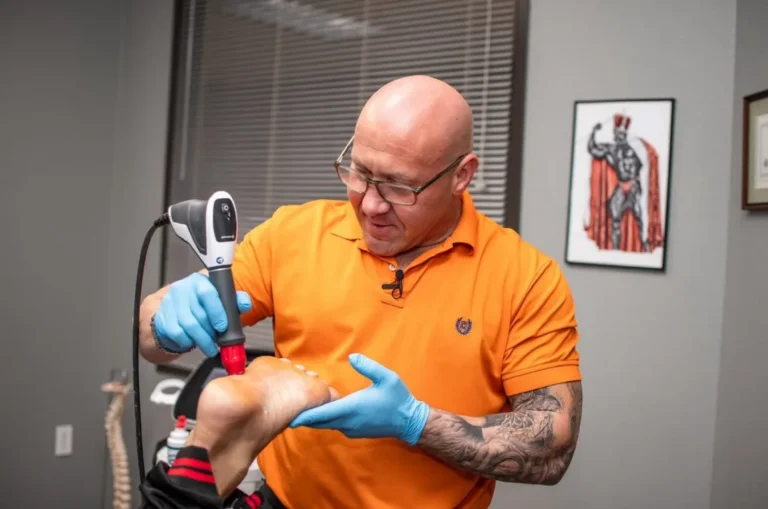
- Radial shockwave therapy for some persistent cases of plantar heel pain, usually pain that has lasted for months despite other care. It is a separate service, offered only after Dr. Tim decides you are a suitable candidate. Not everyone with heel pain needs shockwave.
Muscle Chiropractic uses radial shockwave (radial pressure waves), not focused shockwave. A single session is $103.50 (credit card price), and Dr. Tim explains how many sessions he suggests before you start.
Corrective exercise for heel pain
Exercise is usually the backbone of heel pain care. Dr. Tim chooses and progresses it based on your exam and how your heel responds. Depending on what he finds, you may be shown:
- Calf and foot strengthening, such as slow heel raises built up over time, sometimes with a rolled towel under the toes to load the arch.
- Calf and arch stretching when tightness is part of the picture.
- Foot and ankle control exercises for balance and how your foot handles load.
- Load changes: adjusting walking, standing, running or training while the heel settles, rather than stopping everything.
Dr. Tim shows you how to do each exercise and how much discomfort is acceptable, then rechecks and adjusts the plan at follow-up visits. Exercises are individualized, so check with him before starting a program on your own. How corrective exercise fits into chiropractic care.
What the research shows
In a randomized trial of people with plantar heel pain, adding high-load strength training to stretching improved function more than stretching alone at three months, with similar results by one year (Rathleff et al., Scand J Med Sci Sports, 2015). For chronic plantar fasciitis, radial shockwave improved pain and function more than a sham treatment in a placebo-controlled trial (Gerdesmeyer et al., Am J Sports Med, 2008). Heel pain often takes weeks to months to settle, results vary from person to person, and no treatment works for everyone.
When to see a medical provider first
Seek prompt medical care if your heel pain started after a fall or injury, you can’t put weight on your foot, there is significant swelling, redness, warmth or fever, or you have numbness, tingling or burning in your foot. If you have diabetes or poor circulation in your feet, have new foot pain checked by your physician. Dr. Tim will refer you to your physician, a podiatrist or for imaging when that is the better route.
See it on Instagram
Watch shockwave therapy on the bottom of the foot for heel pain (short reel on Instagram).
Common questions
Do I need shockwave?
Not necessarily. Many heel problems are managed with exercise, soft tissue work and changes to your activity. Shockwave is considered for some persistent cases after an assessment.
Do I need an X-ray or MRI first?
Usually not. Most heel pain is assessed from your history and exam. Dr. Tim will recommend imaging or a referral if something suggests it.
Can I keep walking, working or training?
Often yes, with changes. Dr. Tim will suggest what to modify and how to build back up.
Do you take insurance?
Muscle Chiropractic is cash-based. HSA and FSA cards are accepted, and receipts with procedure codes are available.
Visit us in Glendale
Our only office is at 7155 W. Campo Bello Dr., Building B, Suite B-115, Glendale, AZ 85308. Patients also come from nearby Peoria, Sun City and across the West Valley. Hours and directions · Choose your visit · Call or text 480-740-9619.
Related care: Shockwave therapy · Tendon pain and tennis elbow · Sports chiropractic · Conditions we treat