Shockwave Therapy in Glendale, AZ

Conditions We Treat With Shockwave Therapy
Dr. Tim uses shockwave therapy for a variety of sports injuries and stubborn musculoskeletal conditions, including plantar fasciitis, Achilles tendinopathy, tennis elbow, golfer’s elbow, patellar tendinopathy, shoulder pain, muscle pain around the shoulder blade, knee pain, and persistent muscle and tendon injuries. Treatment is tailored to the individual rather than using the same protocol for every patient.
What Is Shockwave Therapy
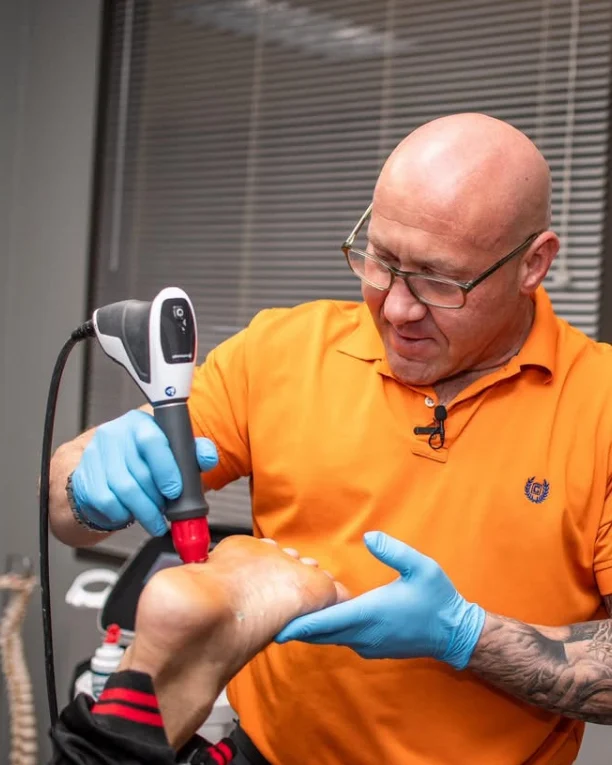
Radial shockwave therapy uses acoustic pressure waves that travel from the applicator into the painful tissue beneath it. It is commonly used for persistent tendon, muscle, and soft-tissue conditions, especially when symptoms have not responded as expected to rest, exercise, or other conservative care. At Muscle Chiropractic, Dr. Tim incorporates shockwave therapy into an individualized treatment plan based on your condition, activity level, and recovery goals.
Shockwave Therapy for Athletes & Active Adults
Training, lifting, running, golf, pickleball, CrossFit, martial arts, and other sports can place repetitive stress on muscles and tendons. Shockwave therapy gives Dr. Tim another non-surgical treatment option for stubborn sports and overuse injuries that interfere with training or performance. Our goal is not simply to reduce symptoms, but to help restore movement, function, and your ability to return to the activities you enjoy.
How Does Shockwave Therapy Work?
Each pulse delivers mechanical energy into the treated area. Research suggests these mechanical signals can stimulate biological responses involved in tissue remodeling, circulation, and the healing process. Shockwave therapy has been studied extensively for musculoskeletal conditions including plantar fasciitis and several chronic tendinopathies. Treatment protocols vary depending on the condition, location, severity, and individual patient.
Why See Dr. Tim at Muscle Chiropractic?
Dr. Tim helps athletes and active adults address persistent tendon and soft-tissue problems with individualized care. After assessing your symptoms, health history, and movement goals, he can determine whether shockwave therapy is appropriate and how it fits into your treatment plan. Dr. Tim Ballitch has been a chiropractor since 2017 and uses radial pressure wave (radial shockwave) equipment in our Glendale office. Learn more about Dr. Tim.
Ready to discuss your options? Schedule with Muscle Chiropractic in Glendale, or call/text 480-740-9619.
See it on Instagram: short videos from Dr. Tim’s @musclechiropractic account, filmed in our Glendale office.
- Watch shockwave therapy on the bottom of the foot for heel pain
- Watch shockwave therapy on the elbow for tendon pain
- See why Dr. Tim uses both shockwave and the ProAdjuster
Is shockwave therapy right for me?
Shockwave may be worth discussing if you have pain in a tendon, or where a tendon or the plantar fascia attaches to bone, that has lasted for weeks to months despite conservative care. Dr. Tim will check whether your symptoms fit that pattern. It is not appropriate for everyone: tell us if you are pregnant, have a bleeding disorder or take blood thinners, have a pacemaker or other implanted device, have a known tumor or infection near the area, had a steroid injection there recently, or are under 18. New swelling, numbness, weakness, fever, or pain after a fall or injury may need a medical evaluation first, and Dr. Tim will refer you when that is the better route.
Where Dr. Tim may consider radial shockwave
Shockwave is only considered for selected, persistent tendon and soft-tissue problems, and only after Dr. Tim examines you. These are the areas covered on our site, each with its own page:
- Heel pain and plantar fasciitis (pain at the bottom of the heel)
- Achilles tendon pain (back of the ankle and heel)
- Tennis elbow and golfer’s elbow (outer or inner elbow)
- Triceps tendon pain at the back of the elbow
- Some shoulder tendon problems, such as calcific tendinitis
- Selected knee tendon or soft-tissue problems
- Some jaw (TMJ) pain, using radial pressure waves over the jaw joint for selected patients
Shockwave isn’t right for everyone, and results vary. If your exam points to something else, Dr. Tim will recommend other care or refer you.
Which visit to book: mainly want to know whether shockwave fits? Book the $52.78 Shockwave Consultation (about 15 minutes; history and exam only, no adjustment or shockwave treatment). New to Muscle Chiropractic and want chiropractic care too? Book a New Patient Visit instead; you don’t pay both. Already a patient? Book an Existing Patient Visit, even for a new problem. See the booking choices.
Heel and elbow pain: what to know
These are some of the most common reasons people ask about shockwave. The research is stronger for some of them than for others, so Dr. Tim explains where your problem fits before recommending anything.
Plantar heel pain (plantar fasciitis)
Typical pattern: pain under the heel that is often worst with the first steps in the morning or after sitting, and that has lasted for months despite stretching, footwear changes or rest. Not every sore heel is plantar fasciitis or needs shockwave: see our heel pain and plantar fasciitis page for how Dr. Tim evaluates it and other care options.
What the research shows: this is one of the better-studied uses. A placebo-controlled multicenter trial found radial shockwave improved pain, function and quality of life more than sham treatment in chronic plantar fasciitis (Gerdesmeyer et al., Am J Sports Med, 2008). A meta-analysis of nine sham-controlled trials also found pain relief, with the most consistent results for focused shockwave, a different type of device from the radial unit we use (Sun et al., Medicine, 2017).
Limitations: not everyone improves, and heel pain can also come from nerve irritation, a stress fracture or other causes that need a different plan. Dr. Tim will tell you if imaging or a referral makes more sense.
Tennis elbow (outer elbow pain)
Typical pattern: pain on the outside of the elbow with gripping, lifting or twisting, often after repetitive use at work, in the gym or on the golf or pickleball court. Not every sore elbow is a tendon problem or needs shockwave: see our elbow pain, tennis elbow and golfer’s elbow page for how Dr. Tim evaluates it and other care options.
What the research shows: results are mixed. An older Cochrane review found little or no benefit (Buchbinder et al., Cochrane Database Syst Rev, 2005). A 2025 umbrella review of meta-analyses found a modest reduction in pain compared with placebo, but no clinically important gain in grip strength (Zhu et al., J Orthop Traumatol, 2025).
Limitations: because the benefit is modest, shockwave is discussed as one option alongside load management and progressive strengthening, not as a stand-alone fix.
Golfer’s elbow (inner elbow pain)
Typical pattern: pain on the inside of the elbow with gripping, throwing or bending the wrist.
What the research shows: very few studies have looked at shockwave for golfer’s elbow on its own, so its effect is uncertain (Testa et al., J Clin Med, 2020).
Limitations: numbness or tingling toward the ring and little fingers can point to ulnar nerve irritation, which needs a different assessment. Dr. Tim checks for this before discussing treatment.
Research on other conditions
- Achilles tendon pain: for pain in the middle of the tendon, adding low-energy radial shockwave to an eccentric exercise program gave better results at four months than exercise alone, though the groups were similar by one year (Rompe et al., Am J Sports Med, 2009). For pain where the tendon attaches to the heel, a recent sham-controlled trial found adding radial shockwave to exercise was no better than sham at 12 weeks (Alsulaimani et al., Clin Rehabil, 2025). See Achilles tendon pain care.
- Calcific shoulder tendinitis: in a randomized trial, shockwave improved pain and shoulder function compared with sham treatment at six months (Gerdesmeyer et al., JAMA, 2003). That trial used X-ray-guided treatment, and the paper does not name the type of shockwave device, so its results may not apply to the radial treatment we use. See shoulder pain care.
- Patellar tendon pain (knee): in jumping athletes still competing, shockwave alone was no better than placebo (Zwerver et al., Am J Sports Med, 2011), so exercise-based care comes first. See knee pain care.
- Muscle pain around the shoulder blade: a review of small trials found shockwave reduced short-term trapezius muscle pain compared with sham or ultrasound, using a mix of devices (Zhang et al., Arch Phys Med Rehabil, 2020). See upper back and shoulder blade pain.
- Other tendon pain: our tendonitis and tendon pain overview explains how exercise, load changes and other care fit together.
These studies used specific devices, energy levels and session schedules. Focused and radial devices produce different waves, so a result from one type does not prove the same result with the other, and neither type is best for every condition. A study result is not a promise of your result.
How to book
- New, with pain or an injury (including if you found us while researching shockwave)? Book a New Patient Visit ($154.13, about 30 minutes). Dr. Tim takes your history and examines you. When appropriate, he gives a chiropractic adjustment and teaches you personalized corrective exercises, including what to stretch or strengthen and how to do the movements. If radial shockwave may help, he can recommend it after the exam; shockwave treatment is billed separately. If you book this New Patient visit, you do not also pay the $52.78 shockwave consultation fee.
- Already a patient? Book an Existing Patient Visit, even for a new problem, or call/text 480-740-9619.
- Only want to know whether shockwave is appropriate? Book the $52.78 Shockwave Consultation (about 15 minutes): history and exam only, to assess whether shockwave fits. Any adjustment or shockwave treatment is separate.
If shockwave is appropriate, Dr. Tim will explain the treatment, its cost and the next booking step before you start.
Book a New Patient VisitCall/Text 480-740-9619
Only want a shockwave evaluation? Book the $52.78 Shockwave Consultation (history and exam only).
Common questions
What does a session feel like?
Dr. Tim uses a Chattanooga Intelect RPW 2, a radial pressure wave (radial shockwave) device, not a focused shockwave machine. You will feel rapid, strong pulses over the sore area. It can be uncomfortable, and Dr. Tim adjusts the intensity based on your feedback. Some soreness or redness afterward is common.
How many sessions will I need?
It depends on the condition and how you respond. Research protocols typically use a short series of sessions rather than a single visit. Dr. Tim will explain his recommendation after your assessment.
At follow-up visits, Dr. Tim evaluates your response using your reported pain on a 0–10 scale and by reassessing movements or exercises that were previously difficult or painful. Your response helps guide whether further treatment is appropriate and whether your plan needs to change. Not everyone needs a package, and no specific result is guaranteed.
How long is a shockwave treatment appointment?
A single shockwave treatment session is reserved as a 10-minute appointment. The device is typically applied for about 3–5 minutes, with up to 2,000 pulses when appropriate for your diagnosis and treatment plan. The 10 minutes is the appointment slot, not continuous device application. The Shockwave Consultation (about 15 minutes) is assessment only, with no shockwave treatment. If Dr. Tim recommends shockwave during a New Patient or Existing Patient visit, it is priced separately at $103.50 per session.
Can I keep training?
Often yes, with some changes to load. Dr. Tim will talk through what to modify while the area settles.
How much does shockwave therapy cost?
New patients with pain or an injury usually start with a New Patient Visit ($154.13, about 30 minutes): history, exam and, when appropriate, an adjustment and corrective exercises. If you only want to know whether shockwave fits, the Shockwave Consultation is $52.78 (about 15 minutes; history and exam only, no treatment). See how to book. If Dr. Tim recommends shockwave, treatment is billed separately from these visits: a single shockwave treatment session is $103.50 and covers one treatment. If he recommends a series, a package of 5 weekly sessions over about 4–5 weeks is $435.10, a savings of $82.40 compared with five individually purchased sessions ($517.50 total). The package is non-refundable, and missed weekly appointments count as used. Prices shown are credit card prices. A cash discount is available when paying at the time of service. If shockwave fits, Dr. Tim explains how many sessions he recommends before you start.
Do you take insurance?
Muscle Chiropractic is a cash-based practice and does not bill health insurance. HSA/FSA cards are accepted.
Is shockwave the same as laser therapy?
No. Shockwave delivers strong acoustic pressure pulses into the tissue, while Class IV laser therapy uses light. They are separate services, booked and priced separately.
Related care
Class IV laser therapy · Soft tissue therapy (IASTM and cupping) · Tendon, elbow and heel pain · Triceps tendon pain (back of the elbow) · Sports injuries · Shoulder pain · Knee pain · Jaw (TMJ) pain · ProAdjuster chiropractic · New Patient Center
Ready to get your pain checked? New patients can book a New Patient Visit with Dr. Tim at our Glendale office (7155 W. Campo Bello Dr., Building B, Suite B-115). Only want to know whether shockwave fits? Book the $52.78 Shockwave Consultation. Already a patient? Book an Existing Patient Visit. Can’t find a suitable time online? Call/text 480-740-9619.